Showing posts with label digital. Show all posts

Monday, November 6, 2023

Two CVSD Educators Recognized for Work Around Technology

Tim O'Leary
Tim O'Leary

Tim O’Leary, currently serving as the Instructional Coach and  Curriculum leader at Shelburne Community School, was recently honored with the Frank Watson Award by Vita-Learn. Tim consistently demonstrates a remarkable dedication to his profession, approaching his work with unwavering professionalism and enthusiasm. His tireless efforts are aimed at enhancing student outcomes through information technology, and he fearlessly engages in initiatives that promote enhanced learning experiences.

As a 2020 Rowland Fellow, Tim, alongside Charlie MacFadyen from CVU, worked on developing an equitable K-12 computer science program across CVSD. Tim is a fervent advocate for educational equity and improved access to technology and computer science. He played a pivotal role in implementing First Lego League groups in all K-8 schools within our district.

In addition to his advocacy and active involvement, Tim is a dedicated member of the Computer Science Teachers Association and serves as a board member for the Vermont chapter. He has been instrumental in advocating for Vermont students' access to the Congressional App Challenge.

The Frank Watson Award, presented by Vita-Learn, recognizes individuals who have made significant contributions to educational technology in Vermont, spanning local, regional, and state levels. This marks the third consecutive year that a CVSD educator has been honored with this prestigious award.

Charlie MacFadyen receiving his award
Charlie MacFadyen was honored with the CS Teaching Excellence Award at the recent New England regional Computer Science Teachers Association (CSTA) meeting. His recognition stems from his exceptional leadership in computer science (CS) both at CVU and district-wide over the past few years.


Charlie holds the role of digital learning leader at CVU and actively instructs computer science classes, contributing to the expansion of CS offerings at the school. Moreover, he dedicates his time to coaching the cyberpatriot team and the math league, while also assisting in the coordination of various events for these groups. His leadership style is characterized by thoughtfulness, creativity, and dedication to staff and students.

The CSTA's CS Teaching Excellence Awards are designed to acknowledge the exceptional teaching efforts of K-12 computer science teachers. Recipients of this award excel in inspiring students to explore the field of computer science, engaging them in learning rigorous standards-aligned CS content, and working towards broadening the participation of underrepresented students in computing.


Wednesday, December 21, 2022

An Award Winning App for a CVU Student


Congratulations to Jaden Parker, this year's Vermont Congressional App Challenge winner!
 
Jaden, a senior at CVU from St. George, created an app called Hollow Valley using JavaScript and HTML programming languages. 

When asked about how it feels to have won this challenge for Vermont, Jaden said, 
"If I had to summarize my feelings about winning down to one word I'd choose empowering. Computer programming is a fiercely competitive sector. While the coding itself is difficult, creating something of your own design requires a different level of creativity than I'm used to. With my app, I put some of my best work forward and a lot of hours. Winning this award makes it all feel worth it. I'm incredibly thankful to my mentors who pushed me to submit my app to this challenge, without the guidance of people like Charlie MacFadyen I wouldn't have been able to have this opportunity."
Jaden provided the following information about his app and the development process.

Please briefly describe what your app does.

My app is a platforming game consisting of three levels. Each level operates on a canvas with platforms drawn using a series of intervals and functions. Each level is re-playable and is accessed through a level-select screen.

What inspired you to create this app?
I was introduced to HTML files and canvases during a computer programming class I took at CVU during the spring of 2022. For my final project I chose to create a simple game. The game I submitted for that class was used as a building off point for the app that I submitted for the contest.

What improvements would you make if you were to create a 2.0 version of your app?
I am currently working on the next version of the app. I will be adding more levels, improving the textures of the platforms, and adding a life-counting system that will make it possible to lose each level.

Where did you do most of the coding for your app?
I did most of the coding on the program VScode, with most of my time spent at home. However, I did spend some time at school in a CVU computer programming class where I am a Teacher’s Assistant, debugging with assistance from some of my students.

Did you create this app as part of a project for school, a coding club, or a similar organization?
The app began as a project for school, and is now a personal project that I hope to improve as I become a better programmer. One day I may even be able to publish the game as a playable app.

Jaden submitted this video describing his app as part of the application process and gave us permission to share it here. 
The Congressional App Challenge is an official initiative of the U.S. House of Representatives, where Members of Congress host contests in their districts for middle school and high school students, encouraging them to learn to code and inspiring them to pursue careers in computer science. Each participating Member of Congress selects a winning app from their district, and each winning team is invited to showcase their winning app to Congress during our annual #HouseOfCode festival. The program is a public-private partnership made possible through funding from Omidyar Network, AWS, theCoderSchool, Facebook, Replit, Accenture, and others.

We remain hopeful that Vermont students will continue to have this opportunity as Becca Balint joins the House as Vermont's representative. 

The 2021 Vermont winners of the Congressional App Challenge, Addison and Max, are also CVU students. We are very proud of the accomplishments of CVU students and are thrilled that their work is being recognized by others.

On a somewhat related note, Jaden was also one of three CVU students who visited Shelburne Community School recently to judge and provide feedback on 5th-graders' app concept presentations.


Congratulations to Jaden, and again to Addison and Max! 


Friday, November 18, 2022

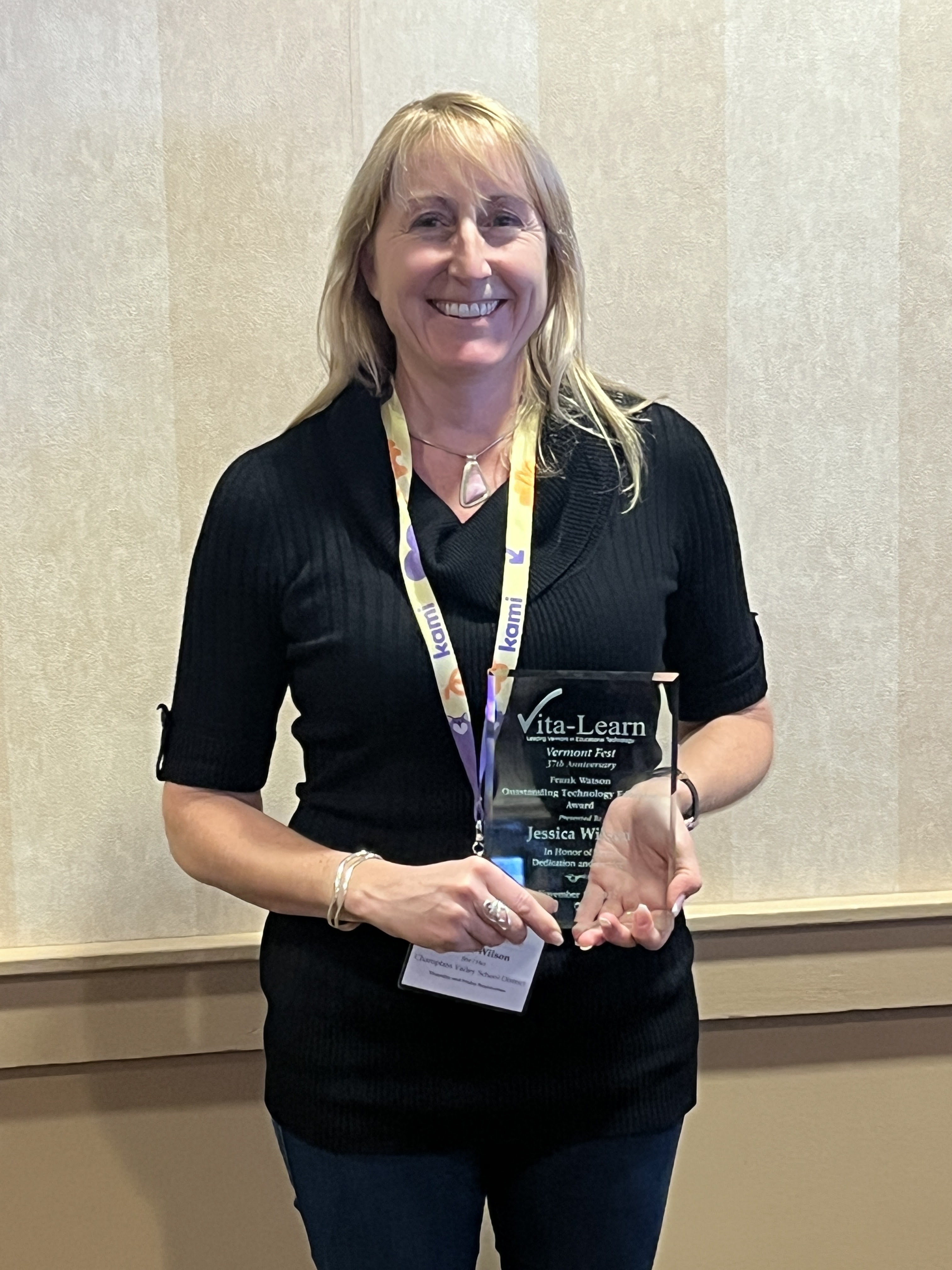
Williston's Digital Learning Leader Wins Award


Williston’s Digital Learning Leader, Jessica Wilson, was presented with VitaLearn’s Frank Watson Award on Friday at their annual Vermont Fest conference in Killington.

The award is presented to a person whose many years of devoted service, vision, and leadership have significantly advanced educational technology at the local, regional, and state level. Jessica has not only served on the board of VitaLearn for many years, Vermont’s ISTE affiliate, but she also served on the board of RETN (now known as the Media Factory) and continues to serve on the board of the Vermont NEA.

Jessica has educated elementary and middle school students at both the Hinesburg Community School and the Williston schools with the state of the art technology through the rapidly changing eras of iPads and Chromebooks. She inspires students and adults to explore new ideas including video production, live-streaming school events, computer animation, coding and more.

Each year, she inspires teachers and their students to participate in the Doodle for Google contest. As a result, an Allen Brook School first grader was last year's Vermont winner.

She is enthusiastic and passionate about digital learning and how digital tools support and enhance learning. Jessica works with everyone in the Williston schools, supporting all efforts that pertain to educational technology. She also serves on Williston’s wellness and safety committees.

Greg Marino, lead principal for the Williston schools, had this to share, 
"The Williston Schools are so grateful for the years of dedicated and expert support of our Digital Learning Leader, Jessica Wilson. Jess is constantly stepping up and stepping in to whatever it takes to advance student learning, especially in areas of transformative and responsible use of digital-age tools in teaching and learning. She serves as a role model to students and adults - not just for what it means to be a good digital citizen, but also a good human being."

We are truly appreciative of all that Jessica does for Williston, CVSD, and others in Vermont.

Congratulations, Jessica!


Tuesday, May 17, 2022

Cookies Are Great... Right?


Who doesn’t want a free cookie? Well, it depends on what kind we’re offering. In addition to chocolate chip and oatmeal raisin, another type of cookie was distributed to some CVU students last week. Read on to learn more.

A few weeks ago, CVU 9th grade student Alex Fox, as part of research about cybersecurity for a Nexus project, shared a survey with all students at CVU. The goal was to see what they knew and thought about a number of topics. Some of the questions included: What are computer cookies? What do you do when you get a cookie pop-up? What is two-factor authentication? Should passwords for all accounts be the same? What do you do when you get spam? What is cybersecurity, why might it be important, and what are the potential benefits and negatives of cybersecurity? Alex reports that they had over 60 responses to the survey and that most people who responded knew very little about cybersecurity.

That survey whet the appetite to help people learn more about computer or internet cookies. Faculty members of CVU’s technology integration committee, led by digital learning leader Charlie MacFadyen, decided to engage students in a related activity to help them learn about internet cookies, using real cookies.

On Monday, May 9, during the lunch blocks at CVU, students were offered a free cookie. All the students had to do to get the cookie was fill out a one-question form. They were asked “Which best describes you?” with options around whether they liked dogs, cats, both, or neither. When filling out the form, it automatically collected their email address. By the way, special thanks goes out to the Redhawk Cafe staff for the delicious cookies!


About 300 students filled out the survey to get a cookie. CVU advisors were told of this activity ahead of time and were asked not to share what it was about with students until later in the week.

On Wednesday, students who filled out the form got an email that looked something like this, depending on their answer to the form.

Hi _____________,

We hope you enjoyed your cookie in the cafeteria!

And since you're a dog person, here's a picture of some adorable puppies. By the way, we also shared your information with dogs.com, so you may be getting their ads soon*.

*Just kidding-- we didn't really share your info with anyone! But guess what? When you accept cookies on the internet, this is often what happens. Cookies are files that save information about your activity on a website. So-called first-party cookies can be helpful so that sites "remember" you the next time you visit (for example, knowing what preferences you chose or what's in your shopping cart). But when you agree to third-party cookies, you allow websites to share your information with other websites (often, for targeted ads). Next time you're asked to "accept all cookies" on a website, try clicking the option to learn more and choose what you agree to.

At the end of the week, ALL students got an email with the general information about this activity. Advisors were asked to show a video (see the first link below) to their advisories and then pose some questions to get the discussion about the experience going. Some teachers reported that these were valuable conversations.

Hopefully, this will help inform more of you about computer cookies, and maybe you’ll think twice before deciding whether or not to accept one next time.

Learn more here:

Thank you to the CVU technology integration committee for sharing this with us!


Wednesday, November 10, 2021

Leading the Way with Digital Learning


CVSD’s Director of Digital Learning & Communication, Bonnie Birdsall, was recently presented with the Frank Watson Award. This honor was bestowed upon Bonnie at Vita-Learn’s annual Vermont Fest Conference in Killington.

As Vita-Learn stated in their press release, “Bonnie is highly-respected among her peers, and she has demonstrated leadership through her actions in her own district and statewide including championing the student data privacy work,” noted Robert Gervais, Technology Director of the Missisquoi Valley School District and Vita-Learn Board President.

The Frank Watson award is presented to a person whose many years of devoted service, vision, and leadership have significantly advanced Vermont educational technology at the local, regional, and state level.

In the nomination, Bonnie is noted for her work around student data privacy, which she is focused on along with CVSD’s network administrator, Mike Kanfer. We shared information about that work in this blog post from 2019. That very important work continues. In addition, Bonnie collaborates with the district’s digital learning leaders and librarians to ensure that there are equitable opportunities for all students in the realm of digital learning. Those groups helped to develop the district’s Digital Learning Plan, completed at the end of the last school year, which guides the district's efforts for the next three years. She believes that technology and digital tools can enhance and support learning, making it possible for students to create, collaborate, communicate, and think critically.

Bonnie was a classroom teacher in Williston for many years before transitioning to the role of digital learning leader there. She has been in her current district position since 2018.

Congratulations, Bonnie, and thank you for the work you do on behalf of CVSD’s students and schools.


Thursday, April 30, 2020

Cracking the Code: Computer Science Gets a Boost

The Champlain Valley School District congratulates both Tim O’Leary (SCS) and Charlie MacFadyen (CVU) on being named fellows by the Rowland Foundation. Tim and Charlie are both Digital Learning Leaders in their schools.

Tim O'Leary and Charlie MacFadyen
The 2020-2021 Rowland Foundation fellowships provide Vermont secondary school educators with a unique professional development and leadership opportunity and resources (through a one-year, $100,000 grant) to positively affect student achievement and the culture and climate of their respective schools. The Foundation supports proposals which:
  • will lead to systemic change in the school, particularly in its culture and climate
  • are visionary and comprehensive (what percentage of the population will they serve)
  • are sustainable after The Rowland Foundation completes its funding
  • are exportable to other schools. The Rowland Foundation is keenly interested in affecting change throughout Vermont.
  • have the complete support of the principal or head of school. This will be a key element of the interview process by the Executive Director prior to the selections.
Tim and Charlie, on behalf of SCS and CVU, have been awarded this Rowland Fellowship as co-applicants who, together, represent a PreK-12 continuum of instruction in the largest district in Vermont. The project aims to address the inequities and marginalization of females, nonbinary, and gender-nonconforming youth that occur within Computer Science (CS) education and the workforce. It envisions a world where all can become creators, change-makers, and leaders. Malala Yousafzai, Nobel Peace prize winner and educational activist, is quoted in their proposal saying, “every girl deserves to take part in creating the technology that will change our world, and change who runs it.”

From their proposal, titled, “Cracking the Code: Closing the Gender Gap in Computer Science,” Tim and Charlie state:
"Over the coming year, the project will support the development of a K-12 computer science program because we believe schools must assume a critical role to create computer science learning opportunities. Otherwise, students will continue to develop identities informed by a world where males far outpace female participation in this area. Nationally, only 28% of the students who have taken an AP Computer Science exam over the last three years identified as female. And, the disparity is 8.5 % greater in Vermont. We bear a responsibility to dismantle this inequality by creating new systems, and we plan to develop a program to do just that."
SCS and CVU are uniquely positioned to engage in this work and embrace an awesome responsibility to share innovative teaching and learning practices as it develops. The school district looks forward to supporting the partnerships and collaboration that Tim and Charlie will lead over the coming year to create a more equitable future for our students.

Tim and Charlie’s proposal to research and implement a framework for the Shelburne Community School will be closely observed so that we can explore this as a model for all of our district PreK-8 schools. Our school district values innovation, design-thinking, and the personalized pursuit of excellence. We are committed to determining ways in which computer science education is provided to all students, PreK-12. The proposal to Crack the Code for SCS and CVU ensures that we’re on the path to success, for all of CVSD. 


Tuesday, July 23, 2019

CCS Recognized for Digital Citizenship

Charlotte Central School has received an award of distinction from Common Sense Education for their work around digital citizenship with students. This is an award that Williston earned a few years ago. All of our schools are striving to receive this recognition, but most importantly, all of our faculty and staff are committed to addressing this topic in many ways and in many realms every day with our students. We are focused on developing digital citizens who contribute positively to the community. Digital citizenship may be defined as the continuously developing norms of appropriate, responsible, and empowered technology use. In other words, how to be safe, kind, and responsible online. 

If you are not yet familiar with the many resources offered via Common Sense Media's website, we strongly encourage you to visit the site. You will find reviews of books, movies, websites, games, and more. There are posts and forums about many topics that we all face today with our children, such as screen time, setting limits, Fortnite(!), and the impact of media.  https://www.commonsensemedia.org/

Congratulations to CCS!


-----------------------------------------------------------------------


Official Press Release: 

Digital media and technology are evolving at a dizzying pace, both unlocking extraordinary opportunities and posing real risks for young people. Students are using the immense power of the Internet and mobile technology to explore, connect, create, and learn in ways never before imagined, both in and out of the classroom. But issues that emerge from this 24/7 connected culture such as cyberbullying, privacy lapses, and uncertainty about which information to trust online, are surfacing both in schools and at home.

Charlotte Central School sees these as teachable moments. We believe that digital citizenship skills have become essential for students in the 21st century, especially in schools like ours that are using technology to transform learning. That’s why we are committed to teaching our students how to think critically, behave safely, and participate responsibly. CCS has just been approved as a Common School, an honor that recognizes our efforts in teaching digital citizenship to young people and engaging the entire school community in this important discussion. The recognition acknowledges our school's commitment to helping students think critically and use technology responsibly to learn, create, and participate.

This honor is provided by Common Sense Education, part of a national nonprofit organization dedicated to improving the lives of kids and families by providing the trustworthy information, education, and independent voice they need to thrive in a world of media and technology.

We are one of the more than 50,000 schools across the country that use Common Sense Education’s groundbreaking education resources. As a result, our students are better equipped to navigate the digital world and use devices for learning.

To learn more about Common Sense Education, visit www.commonsense.org/education.

Sincerely,

Stephanie Sumner and Jen Roth - CCS CoPrincipals


Wednesday, March 13, 2019

CVSD's Challenge to Unplug

The National Day of Unplugging is a “24-hour, global respite from technology. It highlights the value of disconnecting from digital devices to connect with ourselves, our loved ones, and our communities in real time.”

The National Day of Unplugging happened from sundown on March 1st to sundown on March 2nd. Because this was during our school vacation week, CVSD is creating a district-wide day to replicate this Day of Unplugging in ways that are critical, thoughtful, and give teachers the autonomy to determine how that best works for them in their classrooms.

The Champlain Valley School District encourages all educators and students to take the challenge and unplug in various ways on Friday, March 15. Contact your child's teacher to see how they may be taking part. 

We invite families to join in as well! Extend the challenge into the weekend. Afterward, share how you participated as a family as a comment below or on our Facebook page.

"ALMOST EVERYTHING WILL WORK AGAIN IF YOU UNPLUG IT FOR A FEW MINUTES, INCLUDING YOU."
- ANNE LAMOTT

Here are a few resources about Media Balance and Well-Being from Common Sense Education: