Showing posts with label innovation. Show all posts

Monday, June 17, 2024

RISE at CVU 2024

The last two weeks took on a distinct character as the academic year wound down at Champlain Valley Union High School. The regular class schedules and programming gave way to a flurry of final projects, presentations, and assessments. Once these culminating activities were complete, the school transitioned into RISE, an enrichment program that occupied the remaining two weeks before summer break.

RISE stands for Reflective Interest-based, Student Experiences. Students attended either two sessions a day, morning and afternoon, or chose to participate in a full-day session each day. Students might also have explored an Independent Learning Seminar. RISE is a part of the academic school year and attendance is a graduation requirement.

An excerpt from the RISE 2024 Catalog: 
Our current educational model needs regular, system-wide, and equitable opportunities for student to develop and cultivate interests. We believe that RISE better accounts for the whole student (their interests and values), connects to the pursuit of lifelong learning, and will increase engagement and a desire to learn. Our model shows that, as a student-centered school committed to personalization, proficiency, and social-emotional wellbeing; we value the fusion of conventional and flexible learning opportunities to meet the needs of all students. 

Thank you Peter Booth, Carly Rivard, and Luke Dorfman for your incredible efforts to make this experience happen. And thank you to all staff for sharing your interests and passions with students in an enriching way.

Here's a small sampling of some of the varied offerings this year.
  • Art and Activism: Puppets, Power, Protest, and Paint
Puppets? Protest? Join us for an integrated creative and theatrical experience. One of the many uses of art is to communicate, to express thought, to educate, and to motivate. Art and Activism explores the historical and contemporary use of images to create platforms for social issues through art and community engagement. While gaining perspective and context through examination of contemporary artists, we will work together to bring our own passions and interests to the masses. How will we do this? Through the creation of larger-than-life puppets! We will conclude with a theatrical presentation created entirely by participants. 
  • Explore Non-Traditional Career Pathways
The intention for this RISE session was for students to be exposed to a variety of career pathways that may not require a 4-year college degree. We explored regional workplaces and career and Technical centers, with a focus on the fasted growing careers in Vermont, especially the trades. We did some career development work to explore interests and abilities and visited different workplaces that aligned with those interests. The goal was to visit a different place of employment daily off campus so that we could explore all of the careers involved and figure out next steps after high school. 
  • Sports Analytics
Sports Analytics offered an exciting introduction to the world of data-driven sports analysis. Participants learned statistical techniques, explored data visualization, and applied their skills to analyze performance data from various sports. They unlocked the secrets of sports succedss through data-driven insights!

  •  Game Programming

Students learned how to write code to create games of different types. They grew to understand that programming a game is a different experience from playing a game. They looked into the creativity and logic behind creating games. They learned through tutorials, experimentation, and examples from professional game developers. 

  • Linguistics: The Art and Science of Language(s)
    • Why is it so hard to say "She sells seashells by the seashore?" (Phonetics)
    • What's the difference between a tapping bot and a dabbing pod? (Phonology)
    • What is the "cran" in cranberry? (Morphology) 
    • You this sentence can understand - but how? (Syntax)
    • How did 'hlafweard' become 'lord'? (Historical Linguistics)
Participants explored these questions (and more!) by completing linguistic puzzles, investigating word histories, playing language games, composing metrical poetry, and digging into examples from the world's 7000+ languages. 

One session at RISE was called Documenting RISE: Photojournalism in Action. Facilitated by Olivia Gatti, CVU librarian and a Pulitzer prize-winning photographer, a group of students branched out to visit and capture the essence of various RISE offerings, in and out of the school building. See their photos below. (The names on the slides are the photographers.)

Thank you to everyone who helped make RISE a success once again! 


Past posts about RISE: 

2023

2019

The Origins of RISE


Thursday, January 4, 2024

CVU Student Recognized for Innovative App Design


Congratulations to Clay Nicholson, a 10th grader from Williston, who was selected by US Representative Becca Balint's office as this year's Vermont winner of the Congressional App Challenge. Clay submitted the video below as part of his application. In the video, Clay outlined his app called Lexiscan. Clay not only conceptualized the idea but also brought it to life by personally developing the app. In his video, he shares that his motivation stemmed from observing the challenges faced by a friend with dyslexia while reading. We highly recommend viewing the video.

This is the third year in a row that a CVU student has been recognized for this contest! Way to go CVU computer science! 


The Congressional App Challenge is an official initiative of the U.S. House of Representatives, where Members of Congress host contests in their districts for middle school and high school students, encouraging them to learn to code and inspiring them to pursue careers in computer science. Each participating Member of Congress selects a winning app from their district, and each winning team is invited to showcase their winning app to Congress during their annual #HouseOfCode festival. The program is a public-private partnership made possible through funding from Omidyar Network, AWS, theCoderSchool, Facebook, Replit, Accenture, and others.

Thank you to Becca Balint for supporting this effort. At this time, the Congressional App Challenge website has not yet been updated to showcase the 2023 winners. 

See our posts about the other CVU winners! 

Congratulations, Clay!


Monday, November 6, 2023

Two CVSD Educators Recognized for Work Around Technology

Tim O'Leary
Tim O'Leary

Tim O’Leary, currently serving as the Instructional Coach and  Curriculum leader at Shelburne Community School, was recently honored with the Frank Watson Award by Vita-Learn. Tim consistently demonstrates a remarkable dedication to his profession, approaching his work with unwavering professionalism and enthusiasm. His tireless efforts are aimed at enhancing student outcomes through information technology, and he fearlessly engages in initiatives that promote enhanced learning experiences.

As a 2020 Rowland Fellow, Tim, alongside Charlie MacFadyen from CVU, worked on developing an equitable K-12 computer science program across CVSD. Tim is a fervent advocate for educational equity and improved access to technology and computer science. He played a pivotal role in implementing First Lego League groups in all K-8 schools within our district.

In addition to his advocacy and active involvement, Tim is a dedicated member of the Computer Science Teachers Association and serves as a board member for the Vermont chapter. He has been instrumental in advocating for Vermont students' access to the Congressional App Challenge.

The Frank Watson Award, presented by Vita-Learn, recognizes individuals who have made significant contributions to educational technology in Vermont, spanning local, regional, and state levels. This marks the third consecutive year that a CVSD educator has been honored with this prestigious award.

Charlie MacFadyen receiving his award
Charlie MacFadyen was honored with the CS Teaching Excellence Award at the recent New England regional Computer Science Teachers Association (CSTA) meeting. His recognition stems from his exceptional leadership in computer science (CS) both at CVU and district-wide over the past few years.


Charlie holds the role of digital learning leader at CVU and actively instructs computer science classes, contributing to the expansion of CS offerings at the school. Moreover, he dedicates his time to coaching the cyberpatriot team and the math league, while also assisting in the coordination of various events for these groups. His leadership style is characterized by thoughtfulness, creativity, and dedication to staff and students.

The CSTA's CS Teaching Excellence Awards are designed to acknowledge the exceptional teaching efforts of K-12 computer science teachers. Recipients of this award excel in inspiring students to explore the field of computer science, engaging them in learning rigorous standards-aligned CS content, and working towards broadening the participation of underrepresented students in computing.


Friday, August 25, 2023

HCS Awarded An Exciting Grant


HCS is One of Ten Schools and Districts Selected for the Second Cohort!

Hinesburg Community School (HCS) was selected as one of 10 schools nationally to partner with the national education nonprofit organization, Transcend, to be a part of their second cohort of the Rural Schools Design Community. This is a ten-month program where school administrators and faculty will prioritize reimagining their school model to better serve students and families.

At the start of the ten-month program, each school community will identify a core team to lead the process in their communities. Through this program, teams work locally to enlist their broader community in shaping the vision for their reimagined school. Throughout the 10 months, the groups will also engage in convenings, exploring high-impact topics such as generating a community-led school design process to achieve equitable results for all students, understanding the skills and mindsets needed for young people to thrive in and transform the world, learning how to ensure community aspirations and needs are reflected, and understanding school & district design.

The 2023-2024 Transcend Rural Schools Design Community includes:
  • Calistoga Joint Unified School District in Calistoga, CA
  • East Range Academy of Technology & Science (ERATS) in Mt. Iron, MN
  • Elizabeth City-Pasquotank Public Schools in Elizabeth City, NC
  • Hinesburg Community School/Champlain Valley School District in Hinesburg, VT
  • Lasara ISD in Lasara, TX
  • Los Lunas Schools in Los Lunas, NM
  • Riverhead Charter School in Calverton, NY
  • Rugby Public Schools in Rugby, ND
  • Southern Berkshire Regional School District in Sheffield, MA
  • Warren County Schools in Warrenton, NC
The Rural Schools Design Community will take place at no cost to participants thanks to a grant and will commence in August of 2023.

We will provide updates when the work gets underway. Congratulations HCS!


Friday, November 18, 2022

Williston's Digital Learning Leader Wins Award


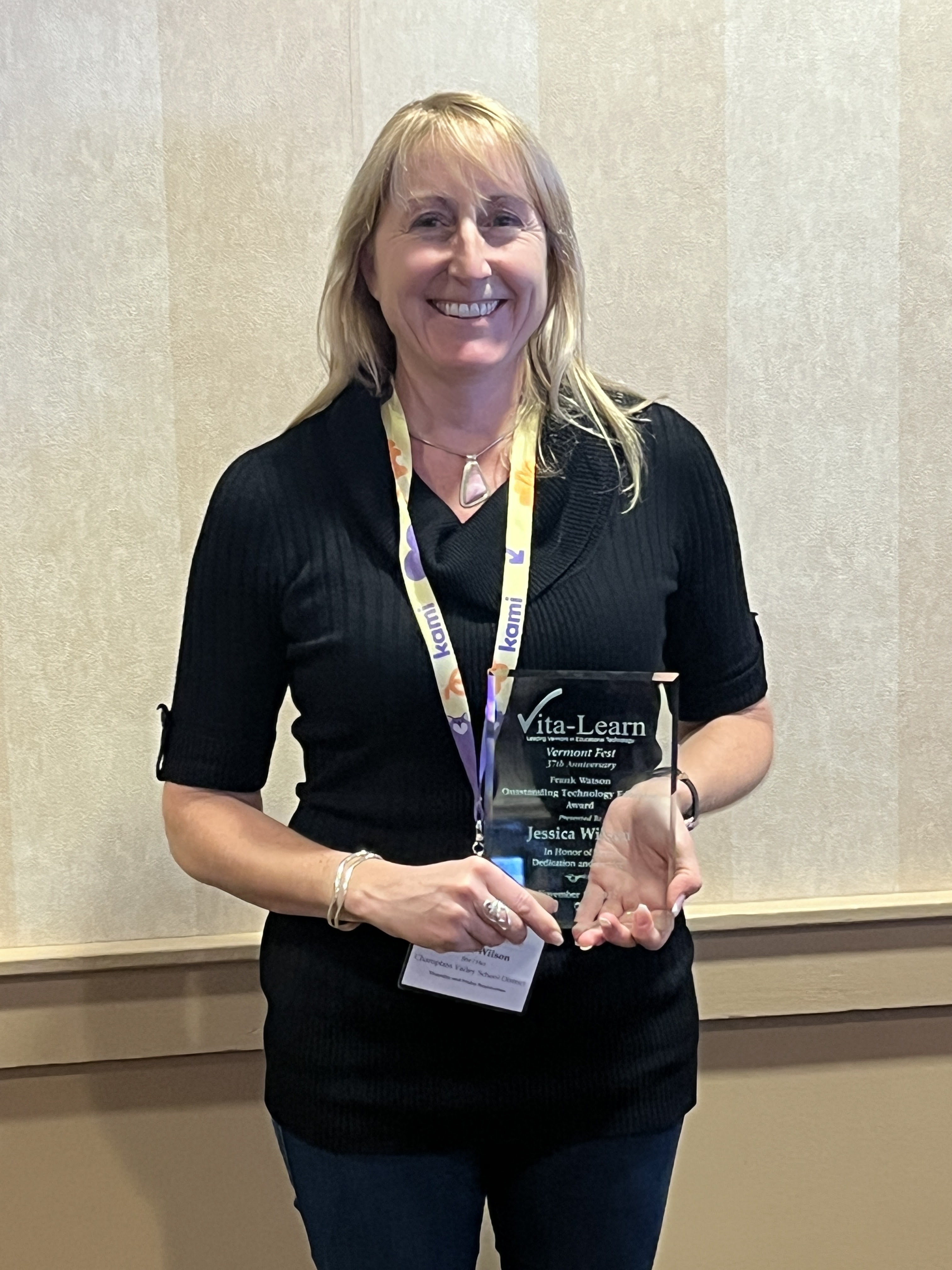
Williston’s Digital Learning Leader, Jessica Wilson, was presented with VitaLearn’s Frank Watson Award on Friday at their annual Vermont Fest conference in Killington.

The award is presented to a person whose many years of devoted service, vision, and leadership have significantly advanced educational technology at the local, regional, and state level. Jessica has not only served on the board of VitaLearn for many years, Vermont’s ISTE affiliate, but she also served on the board of RETN (now known as the Media Factory) and continues to serve on the board of the Vermont NEA.

Jessica has educated elementary and middle school students at both the Hinesburg Community School and the Williston schools with the state of the art technology through the rapidly changing eras of iPads and Chromebooks. She inspires students and adults to explore new ideas including video production, live-streaming school events, computer animation, coding and more.

Each year, she inspires teachers and their students to participate in the Doodle for Google contest. As a result, an Allen Brook School first grader was last year's Vermont winner.

She is enthusiastic and passionate about digital learning and how digital tools support and enhance learning. Jessica works with everyone in the Williston schools, supporting all efforts that pertain to educational technology. She also serves on Williston’s wellness and safety committees.

Greg Marino, lead principal for the Williston schools, had this to share, 
"The Williston Schools are so grateful for the years of dedicated and expert support of our Digital Learning Leader, Jessica Wilson. Jess is constantly stepping up and stepping in to whatever it takes to advance student learning, especially in areas of transformative and responsible use of digital-age tools in teaching and learning. She serves as a role model to students and adults - not just for what it means to be a good digital citizen, but also a good human being."

We are truly appreciative of all that Jessica does for Williston, CVSD, and others in Vermont.

Congratulations, Jessica!


Monday, October 25, 2021

C3 at CVU: Connect, Clubs, Communities

We thank Emily Rinkema, proficiency-based learning coordinator and educator extraordinaire, for this guest post. 


This year, CVU implemented a significant schedule change in the middle of a global pandemic. While any significant change during such a time may seem like a risky idea, one that added transitions to an already hectic day, required widespread participation of already overwhelmed humans, cut academic time in classes that already felt overpacked, and depended upon last minute flexibility in an already over-flexed system may seem like a downright stupid idea.

Believe us, there have been times (and still are weekly), when we believe it was a downright stupid idea. But then we walk around the building during C3, the 20 minute block (with 5 minute passing on either side) between blocks three and four. There are students painting each other’s nails in Nail Salon, singing along to classic rock and doing puzzles in Music and Puzzles, shooting baskets in Open Gym, talking about sustainability in the Environmental Action Club, planning a campaign to increase understanding about gender in the Gender Sexuality Alliance, learning to breathe in the Meditation and Mindfulness Club, and learning about strategy in the Investment Club. In some classrooms there are just a few students connecting with their teachers about classwork, in others there are dozens who chose to be in a space with students who have similar interests. Some rooms are silent, with students reading together, and others are filled with students cheering each other on in a massive game of Uno.

C3 stands for Connect, Clubs, and Communities, and was born out of the need to increase equity of access to clubs, increase opportunities for belonging, and provide the time and space for teachers and students to connect academically and socially. It is a regular part of every school day, though Fridays during C3 are currently being used to have an extended advisory experience.

The first C, Connect, is not new to CVU. We have tried different versions of Connect in the past, and while teachers and students found it valuable, there were many things that prevented it from catching on in our system. This year, the regularity, increased time, and improved scheduling software have made it the most successful iteration of Connect yet. Teachers can request students to meet with them, and students can request to meet with teachers. Connect is often a time to check in about a skill or concept that a student is struggling with, to finish an assessment started in class, or to be proactive about upcoming absences. Most students only connect once a week at most, which allows plenty of opportunities for the other two Cs.

The second C is for Clubs. In the past, clubs met before or after school, which significantly limited accessibility. Students who couldn’t get rides to or from school often couldn’t participate, and students who had other activities or responsibilities couldn’t participate. There were also limited numbers of clubs, as club advisors also had to be available before or after school. Now, all clubs meet during the actual school day, so every student can access them (some clubs also meet after school in order to do the activities involved with the club), and because there are four days of C3, many students are now involved in multiple opportunities.

Girls Who Code

The final C is for Communities, which are similar to clubs, but more flexible with involvement and require less preparation. The communities are built around common interests, and students or adults can propose them. They are spaces students can sign up to go to from week to week, and there are frequently new and different offerings. The goal of the communities is to provide places for students and adults to connect in non-academic ways.

As of this week, we have 55 clubs and 28 communities for students to choose from, but this changes week to week as students and adults propose new opportunities.

Board Games

At the center of the C3 experience is belonging. We know that students who feel like they belong to one or more groups are more engaged in school and overall more healthy, so we wanted to maximize the opportunities to build that sense of belonging. Floyd Cobb and John Krownapple, authors of Belonging Through a Culture of Dignity: The Keys to Successful Equity Implementation, write about the importance of belonging to student well-being. “We define belonging as the extent to which people feel appreciated, validated, accepted, and treated fairly within an environment. When students feel that they belong, they aren’t worried and distracted about being treated as a stereotype or a thin slice of their multidimensional identities (Willms, 2000). Instead, they are confident that they are seen as a human being, a person of value. Belonging isn’t just a nice sentiment or a word on a Hallmark greeting card. It’s a need that’s hardwired into human beings. Like neglecting the need for food or water, neglecting belonging is hazardous to our health.” We believe that C3 provides the foundation to build belonging for all of our students.

C3 implementation has not been easy. We are still figuring out ways to shift our systems and make adjustments so that we can sustain and continue to grow what we know is a valuable program. Students have been amazing--so excited about getting to try new opportunities and find what they love to do, whether it’s learning how to debate formally or spending time making friendship bracelets with their peers. Faculty and staff have been so patient and flexible, filling in where needed at the last minute, volunteering to facilitate communities that students suggested (who knew so many high schoolers would want to play pickleball?), and adapting their long-standing clubs to fit a new schedule. And the administrators have been brave and creative and supportive and encouraging, even when the thought of 1,200 students making choices about where they want to be and what they want to do may keep them up at night.

While moving forward with an idea like C3 during a global pandemic was a risky idea, it was the right idea. I am proud to work in a school and be in a community that doesn’t shy away from risk when it comes to doing the right thing for our students.


Thursday, April 30, 2020

Cracking the Code: Computer Science Gets a Boost

The Champlain Valley School District congratulates both Tim O’Leary (SCS) and Charlie MacFadyen (CVU) on being named fellows by the Rowland Foundation. Tim and Charlie are both Digital Learning Leaders in their schools.

Tim O'Leary and Charlie MacFadyen
The 2020-2021 Rowland Foundation fellowships provide Vermont secondary school educators with a unique professional development and leadership opportunity and resources (through a one-year, $100,000 grant) to positively affect student achievement and the culture and climate of their respective schools. The Foundation supports proposals which:
  • will lead to systemic change in the school, particularly in its culture and climate
  • are visionary and comprehensive (what percentage of the population will they serve)
  • are sustainable after The Rowland Foundation completes its funding
  • are exportable to other schools. The Rowland Foundation is keenly interested in affecting change throughout Vermont.
  • have the complete support of the principal or head of school. This will be a key element of the interview process by the Executive Director prior to the selections.
Tim and Charlie, on behalf of SCS and CVU, have been awarded this Rowland Fellowship as co-applicants who, together, represent a PreK-12 continuum of instruction in the largest district in Vermont. The project aims to address the inequities and marginalization of females, nonbinary, and gender-nonconforming youth that occur within Computer Science (CS) education and the workforce. It envisions a world where all can become creators, change-makers, and leaders. Malala Yousafzai, Nobel Peace prize winner and educational activist, is quoted in their proposal saying, “every girl deserves to take part in creating the technology that will change our world, and change who runs it.”

From their proposal, titled, “Cracking the Code: Closing the Gender Gap in Computer Science,” Tim and Charlie state:
"Over the coming year, the project will support the development of a K-12 computer science program because we believe schools must assume a critical role to create computer science learning opportunities. Otherwise, students will continue to develop identities informed by a world where males far outpace female participation in this area. Nationally, only 28% of the students who have taken an AP Computer Science exam over the last three years identified as female. And, the disparity is 8.5 % greater in Vermont. We bear a responsibility to dismantle this inequality by creating new systems, and we plan to develop a program to do just that."
SCS and CVU are uniquely positioned to engage in this work and embrace an awesome responsibility to share innovative teaching and learning practices as it develops. The school district looks forward to supporting the partnerships and collaboration that Tim and Charlie will lead over the coming year to create a more equitable future for our students.

Tim and Charlie’s proposal to research and implement a framework for the Shelburne Community School will be closely observed so that we can explore this as a model for all of our district PreK-8 schools. Our school district values innovation, design-thinking, and the personalized pursuit of excellence. We are committed to determining ways in which computer science education is provided to all students, PreK-12. The proposal to Crack the Code for SCS and CVU ensures that we’re on the path to success, for all of CVSD. 


Friday, November 8, 2019

New Murals At WCS


If you walk into Williston Central School any time soon, you're bound to notice some incredible new art greeting you. Teachers Julie Rogers and Sara Beeken submitted and were awarded a CVSD Innovation Grant to make this possible. Artist-in-residence, Sally Duback, worked with students to create these powerful, bright, and welcoming installations. Julie provided us with more information about the project and outlined the next phase.

The smaller of the 2 murals (4' x 6') is entitled "All Are Welcome"  and was completed by 3rd and 4th graders. It is located in the front entrance on the left as you enter the building. That space has particularly nice lighting and welcomes everyone into the building. The larger of the 2 murals (6' x 12') is just inside the back entrance to the building which gets a lot of traffic as well. That mural is entitled " Sustainable Vermont".

Students were asked to make drawings about the themes of diversity & inclusion and sustainability. Students began by discussing what the themes meant to them and then sketched designs. The student sketches were sent to Sally Duback who took bits and pieces from them, traced them onto good old fashioned overhead paper, and composed a cohesive piece with many students' work represented in each. The students took that design and using an overhead projector then copied the design onto the large wooden mural boards (1 board for the smaller one and 3 boards for the larger one). Then the painting began. First backgrounds and sky, then outlining and detail, all the while adding layers and shading. Finally they added shadows and touch up work. It was really an amazing process to watch. Sally is amazing!

We have an artist scheduled for January and another in March which center around photography and kinetic art. There is a possible 3rd artist but we haven't worked out the details for that as of yet. 

Here are some photos of the work in progess. Go see these murals; they are stunning!


Monday, December 17, 2018

Middle School Students Attend Empower Youth Conference


This post was written by Hinesburg Community School educator Mary Muroski. It's a follow up to this post from July of this year. 

On December 6th, 2018, ten of Hinesburg's 6th, 7th, and 8th grade students attended the Empower Youth Leadership Conference at the Holiday Inn, Burlington. They were joined by 40 other students from towns in Vermont, including Shelburne, Charlotte, Williston, Winooski, Burlington, Grand Isle, and South Burlington. The students participated in workshops designed to build personal leadership skills.

The day started with middle schoolers working with student facilitators to establish their hopes and dreams for the world. These ideas were shared with students in Uganda via a live Skype conversation. As the day progressed, students engaged in activities aimed to enhance communication skills. Highlights included creating vision boards that identified future goals and learning about the power of nonverbal communication. In a workshop on money smarts, students learned about credit, debt, investing, and compound interest. The day ended with students learning how to practice and express gratitude as a way to bring abundance and positivity into their lives.

The event was organized by Hinesburg Community School teacher, Mary Muroski, and Charlotte Central School Counselor, Kathy Batty, and co-sponsored by the Children’s Legacy Partnership through a grant from the NOVO and Education First Foundations. Local sponsors, who helped with the event, included Larkin Realty, Holiday Inn Burlington, New England Federal Credit Union, and Lantman’s Market in Hinesburg. Another conference will be held in March and more of our students will be invited to attend. It was so heartening to see the insight that these future leaders have to make the world a better place for all!