Showing posts with label humanities. Show all posts

Thursday, November 16, 2023

What is Harkness?

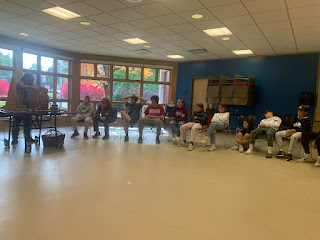
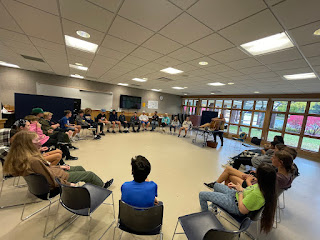
Recently, CVU's 10th and 11th grade Harkness Building Coaches traveled to Harwood Union High School to participate in Harkness discussions with their counterparts at that school. The pictures below show a trust-building warm-up activity and then discussions completely led by students. In particular, CVU and Harwood 11th graders - who have a bit more training than the 10th graders - facilitated the discussions for the 10th graders. As is typical in high-quality Harkness, all the teachers had to do was sit back and observe. Magic only begins to describe it.

CVU will host Harwood's Harkness Building Coaches for a similar summit on Thursday, December 14.

We asked Brad Miller, a CVU social studies teacher to help our community learn more about Harkness. Here are his responses in a question/answer format. Thank you for your leadership on this valuable work, Brad! 

What is Harkness?

The Harkness Method began in 1930 at Phillips Exeter Academy in Exeter, NH, and is still their primary mode of instruction today. It has since become very popular in the private school world, in large part due to Exeter’s renown.

In short, The Harkness Method asks that students be responsible for their own learning. Instead of the teacher being the sole deliverer of content, students are taught to engage with each other using the tools of civil discourse, taught to engage with content through annotation and questioning, and then taught to make sense of that content together ‘at the table’ (pictured above) using those tools of civil discourse. The teacher’s role is more to steer discussion and collaboration towards key understandings rather than leading them to those understandings through lectures.

Does Harkness at CVU look the same as Harkness in private school?


No. CVU - or any public school - can’t replicate the private school model. Instead, we teach a Harkness curriculum that operates within our capacity. We use highly scaffolded steps to bring our students ‘to the table,’ so to speak. While our version takes more time and has more steps, many CVU students at this very moment are skilled enough that they could sit down at the table with Exeter students and you wouldn’t notice a difference.

What’s the difference between a Harkness discussion and a Socratic Seminar?

Think of Socratic Seminar as one of the final steps along the Harkness process. Socratic Seminar is a discussion in which the teacher comes prepared with questions for the students to answer in order to achieve an understanding about content. Harkness pushes one step past that and instead asks the students to be the ones preparing questions. They would then engage each other in discussion, with the teacher there to provide direction and quality control.

Are Harkness discussions just freewheeling, dorm room-style riff sessions?


No. Successful Harkness teachers prepare vigilantly beforehand to make sure that their discussions are ones in which there aren’t interruptions, there is clear direction, content is the driver, and every voice matters. A student won’t be successful at Harkness simply by talking the most. The quality of their comments and their active listening are more important than their ability to talk a lot.

Is Harkness just meant for the Humanities classroom?

No, but Harkness does look different in different disciplines. For example, it’s totally reasonable for Humanities teachers to expect their students to be able to sit in circles of 10-12 and have discussions about content. That might not be applicable to, say, a math or science classroom. Instead, in that context, Harkness might look like groups of 4-6 collaborating on problems or labs. One is not more valuable than the other, especially since the same skills of civil discourse can be taught and assessed. The teacher’s goals, how students reflect, and what’s being assessed are all potential commonalities between Harkness in different disciplines at CVU.

What’s the difference between Harkness and a debate?

Harkness isn’t a setting in which students seek to ‘win’ or ‘own’ each other, as they might say. It’s a setting in which students are asked to unpack complex content together through civil discourse. Sure, disagreement is a natural part of Harkness, but ‘winning’ is not something that’s prized within the pedagogy. Perhaps a teacher might use a Harkness discussion to help their students prepare for a debate.

What's the current status of Harkness at CVU? 

An after school class to help educators learn about Harkness is now in its third year and I’m proud to say that my co-teacher, Kathy Cadwell, (from Harwood) and I have trained 27 CVU teachers in the Harkness Method. Over and over again, I have seen that Harkness allows students to be heard, to take risks, and to experience a much more equitable version of classroom discussion than I had used in the past.

How many CVU students have been trained in Harkness?

Every single 9th grader received training last year. Additionally, most current juniors participated in some degree of Harkness training during their 9th-10th grade years. The ripple effects that teachers are seeing in their 10th and 11th-grade class discussions are profound.

What do CVU students like about Harkness? 

The responses below come from anonymous surveys given to 9th graders last year.
  • I liked the emphasis on including everyone in the discussions.
  • I liked the passionate discussions, how it was so polite without any interruptions and I loved the vibe of the room.
  • We didn't interrupt, like, at all, and that was great, as that's something I get mad at my friends for doing. I think we all had great points to share too.
  • I think I did a good job listening to others and letting others talk. I have a tendency to talk for a long time, and I think I did a good job holding back and letting others have the floor.
  • We had a lot of really good connections to things you would never think of connected to what we were talking about. Hearing these made what we were talking about easier to understand.
  • I think it gave me some new ideas and a deeper understanding of the units than I would have learned on my own.
  • I liked to hear everyone's ideas, and I liked to see my classmates growth.
  • It was a good way to get ideas for the LEAF formatives and summatives. I also think it was a good way to get comfortable with sharing your ideas to a group and potentially disagreeing with others.
  • I felt like I was heard and my opinions were valued. I didn’t feel embarrassed when I messed up or stumbled over my words. I felt very included.
  • It is really hard to be actively in the discussion if you are not prepared.
  • I really liked how we had a lot of control as the students.


Friday, March 31, 2023

Students Shine at the VAMLE Conference

Here's a guest post submitted by Lynn Camara. Lynn is a student assistance program (SAP) counselor at Williston Central School (WCS). 

Students from Charlotte Central School and Shelburne Community School also attended the conference.


On Thursday, March 16, WCS sponsored a group of twenty-six 6th, 7th, and 8th graders to participate in a day-long conference at Champlain College. The event was hosted by the Vermont Association for Middle Level Education (VAMLE) and featured workshops relevant to adolescents. It was an incredible conference with 350 middle school students from all over the state. Our students were very engaged in the learning opportunities, they took positive risks, and were terrific ambassadors of WCS.

Jared Bailey, a 5th & 6th grade Sterling House teacher at WCS and the president of VAMLE, gave an opening welcome speech to all of the conference attendees. Then WCS Sterling House 6th grader Eisley Devitt read the Land Acknowledgement to the large crowd. Later in the day Mr. Bailey, Eisley, and other Sterling House students, Anna Thorley-Doucette, Annika Scott, Teague Flattery, and Varian Theriault facilitated a workshop on “Implementing Social Courage.”


The guest speaker was Bennett Townley from Special Olympics Vermont. Bennett is a graduate of WCS and Champlain Valley Union HS. He spoke of his experiences being treated unkindly and being excluded as a middle school and high school student. He found a wonderful sense of community in the Unified Sports program at CVU and shared his excitement about being part of a basketball team. Audience members found his talk to be inspirational and heartwarming.


Later in the morning students participated in a variety of workshops relevant to middle school students. In addition to the “Implementing Social Courage” workshop presented by a group of WCS students, other workshops included: Alternatives to Hazing in Athletics, Creating Change in Your School, Responding to Social Media, Unified School Communities, Organizing Against Racism, Learning About Gender, Pronouns, and Sexuality, among others.

The students returned to WCS excited to share what they have learned with their peers.


Nora Brady, a WCS 6th grader, said "It was a really fun experience. It was amazing to see students from all over Vermont. There were a lot of people there all learning from each other.” "This conference was a great learning experience," said 8th grader Malashie Tonokie. "It reinforced that when students can express themselves, they can become leaders. Student voices make student leaders!"


Seventh grader Orion Power-Freeman said of the day at Champlain "It was really great to see the diversity of students from all over Vermont. I loved knowing students all over are working on the same issues we are here at WCS." These students were terrific ambassadors of WCS and did a great job jumping in and participating in the conference!


Note: VAMLE is the Vermont chapter of the Association for Middle Level Educators (AMLE). WCS educator Jared Bailey, the president of VAMLE, added this perspective, "It was our largest conference ever. It's also the only AMLE chapter conference that is run by students for students. It was great to see students from all over the state come together to share concerns, learn from each other, and leave with ideas on how to make their communities better! We hope to see many of this year's attendees back as presenters next year!"


Wednesday, October 26, 2022

Abenaki Guest Speaker at WCS

This guest post was provided by Brie Healy, Williston Central School educator. 


Abenaki visitor presents

On Friday, October 14, 2022, Clover and Summit House students welcomed Michael Descoteaux, a member of the Abenaki tribe, in recognition of Indigenous Peoples Day. 

In reflecting on the presentation, Summit 8th grader Reed Claro, shared, 
“Michael opened up a whole new world in our history. In his amazing presentation, we learned so much about the origins of many of the words we speak, as well as the uses and origins for our food. The Abenaki culture and language is a vital part of our history and cannot be taken away from us. Michael and so many others are working to restore and keep the language and culture alive, and by giving him an hour of our time, we can do the same.” 
In addition, Summit 8th grader, Kendall Batdorf shared, 
“I enjoyed hearing about how they built their houses, fought and defended themselves, caught their food, built their gardens, and preserved their food. Some people got grossed out about how they used all parts of the animal and didn’t waste almost anything, but I found it interesting and caring. It was important to the Abenaki to not waste anything that they killed, but to get the most use out of it. This makes so much sense! Nowadays we are killing whole sharks just for their fins!” 

What a valuable learning experience, thank you Michael!

Abenaki visitor with students
abenaki visitor


Monday, October 10, 2022

Williston Candidates' Forum a Great Success


Last Friday, the middle school students at Williston Central School hosted their biennial Candidates' Forum. The teachers and their students invited the Republican and Democratic candidates for US Senate, US House of Representatives, Governor, Lt. Governor, and Attorney General.

Various candidates for federal and state offices were invited and nine were able to attend. This is a great opportunity to inform students and educate them about the political issues facing voters in the November elections. These are the offices our 7th and 8th students were busy researching and preparing questions for. The 5th and 6th grade students also studyed the candidates, political parties, and issues of the election. They created posters that lined the walls in the school and auditorium. Following the forum, students will use the evidence from the forum for a writing assignment.

“The Williston Candidate Forum is an authentic way for our students to learn about democracy. It encourages students to thoughtfully engage in the process of educating themselves about relevant issues and asking questions to further their understanding of the topics,” said Jackie Parks, Williston Central School Building Principal. “Ultimately we want students to become active in their communities and this learning experience provides them with the foundation to build on as they grow into responsible and involved citizens.”

The following candidates and the office they're running for attended this year's forum: 
  • Gerald Malloy (R), US Senate
  • Peter Welch (D), US Senate
  • Becca Balint (D), US House of Representatives
  • Phil Scott (R), Governor of Vermont
  • Brenda Siegel (D), Governor of Vermont
  • Joe Benning (R), Lt. Governor of Vermont
  • David Zuckerman (D), Lt. Governor of Vermont
  • Michael Tagliavia (R), Vermont Attorney General
  • Charity Clark (D), Vermont Attorney General
In addition to posing challenging questions to the candidates, some students were behind the cameras livestreaming and recording the event. They had support from the Media Factory. The complete recording can be seen at this link, thanks to the Media Factory. 

This was the 12th candidate forum sponsored by the social studies committee at WCS. Thank you to this exemplary group of teachers for preparing your students so well!

Here's a small sampling of photos taken at the event.


View additional coverage of the event from local TV stations.
WPTZ: Vermont Students Meet with Candidates During Forum
WCAX: Students Questions Vermont Candidates on the Issues


Friday, June 11, 2021

Climate Change: Don't Ignore the Signs

Shelburne Community School students on the Yellow Team worked with art teacher Carin Lilly to illustrate their learning in new ways. Thank you to Carin and Yellow Team teacher, Robin Halnon, for your guidance on this project and for providing the following information about it to inform all of us about this important topic. 


Climate Change: Don't Ignore the Signs is a collection of art produced by 7th and 8th grade students, that is based on research around climate change. Their work is inspired by the threat of global warming and widespread effects of climate change. They are raising their “voices” in the hopes of having an impact on awareness and to inspire personal decision making that supports efforts to reduce atmospheric greenhouse gases. Working off of a central website, students inserted their own art and then linked it to their own sites with their artist's statements and research. It is a treasure trove of art and research!

Climate Change: Don't Ignore the Signs


Thursday, May 27, 2021

A Passion for Flight

Here's one example of a student project with some exciting outcomes. Jonah Wayman, a 6th grader at Williston Central School chose to study electric planes for his end of year Genius Hour project. After reaching out to a local expert, he connected with Beta Technologies, an electric airline company in South Burlington. On Wednesday he had the experience of a lifetime! This will have a very positive impact on his research.

WCS Humanities teachers Jared Bailey and Joy Peterson provided some highlights of Jonah's experience. 
Jonah (and Jared too!): 
  • was flown in a helicopter by the pilot of Barack Obama's Marine One
  • looked through the two prototype planes they currently operate (one cargo, one passenger)
  • used the flight simulator
  • met the engineering team and flight team
  • had lunch with the staff
  • toured the scale model lab
The company is also planning a flyover of WCS for the learning team's open house on Friday, June 11th with two electric planes and the helicopter.

The Williston Observer shared this story about the experience with more information about Beta Technologies. Note the similarities between Jonah and their CEO! 


Thanks to Jared Bailey for the photos!


Friday, November 22, 2019

CCS 7th and 8th Graders Work with the Clemmons Family Farm

CCS Omega students had a wonderful afternoon earlier this week! This visit was a collaboration around the Vermont Reads book March, Book 1, and was made possible by the Clemmons Family Farm with the support of a Schip's Grant.


Social Justice Workshop with Clemmons Family Farm

All seventh and eighth grade students participated in a workshop that touches on social justice include themes like identity, diversity, courage, and helping one another in the face of injustice. This work connects to the earlier field trip this year to CVU and the reading many did this summer of March (and other books). Four artists came in to share their own experiences and skills with the students.

Group 1
Mr. Desmont, Visual artist #1/Painting activity: The students engaged in a painting activity. He added in stories of his childhood in Haiti

Group 2
Miss Hannon, Visual artist #2/Drawing activity: The students did a line-drawing activity.

Group 3
Mr. Dyke, Musician/Musical storytelling activity: Mike brought some musical instruments and told stories of Jamaica and how music was used to combat poverty and achieve education for many young people growing up there

Group 4
Ms. Edsomwan, Poet/Poetry activity: She shared a presentation about her own story and did a poetry activity with the students.


Thanks to Karyn Lunde for the photos in this slideshow and to Heidi Huestis for sharing the details for this post. 


Wednesday, November 13, 2019

SCS Students Create a Digital Tour of the Shelburne Museum


It's never too late to share exciting happenings as a part of the CVSD story! This project happened a few weeks ago with the 6th graders at Shelburne Community School. Teacher Diana Rich contributed the following to help describe the work.

This was our 3rd year doing a project based learning partnership with the Shelburne Museum and we were supported by the museum educators, Mollie Davis and Holly Miller. 

The driving question for this project is: "How do we as historians create a digital tour that engages middle level students?" 

At the project launch, students experienced a "boring tour" and then they were presented with the task of creating a digital tour. The students gathered evidence and analyzed evidence from the museum and created a digital map using the platform ThingLink. 

Here is one of the projects created by 4 students. This was the first year that all 6th graders at SCS experienced this project.


Friday, April 19, 2019

A Mock Trial Helps Students Learn About Argument Writing

This guest post was submitted by 3 students in Harbor House, a grade 7-8 middle school team at Williston Central School. Thank you to Elizabeth, Ava, and Abby for sharing your perspective on a recent Humanities unit of study. 


Last week in Language Arts class we had a trial about whether or not the US was right to drop the two atomic bombs on Japan at the end of WWII. We think everyone in our class enjoyed it a lot. 

We were split into different roles, it was all pretend, but the acting part of the activity really enhanced it. We split into two legal teams (prosecution and defense) of five people each. In addition, there were several witnesses that were called to the stand including a Japanese survivor, military advisers, doctors, President Truman, and some expert witnesses. The press researched newspapers and articles of 1945 and then interviewed witnesses and created a newspaper. 


Each team had to research and find evidence to support their side of the trial. Each team had a different part to play and while everyone had the same amount of work to do, it looked different depending on their role. The legal teams worked on making a opening statement to present to the judge. They also had to make up questions that they would interview their witnesses with, along with questions for the opposing teams witnesses. The witnesses (Japanese survivor, doctor, President Truman, Military advisers) had to research about their roles in real life and what the role's point of view was. This helped improve the arguments on both sides. 


The trial itself was like a game. One side would bring a fantastic piece of evidence and the other would try to top it off. It was intense, but in the end, we all really enjoyed this way of learning about argument writing.


Humanities Learning targets being assessed through this work:
Claim: I can make a claim that connects my topic to a relevant big idea
Evidence: I can use credible pieces of evidence to support my claim.
Reasoning and Analysis: I can identify and interpret explicit evidence and implicit ideas that lead the audience to a deeper understanding of how they support my claim.
Grammar, Usage, and Mechanics: I can independently apply standards of punctuation, spelling, grammar, and word use.